
Demo design and writing by Katie Trottier MSc – Ruminant Specialist with Perennia Food and Agriculture
One of our multi-year OFCAF demonstrations aims to show the effect of rotational vs continuous grazing on root development and depth using a rhizotron. Picture a large “reverse aquarium” inserted in a field to look outwards at roots and soil. That’s a rhizotron! Our field house houses one in a demonstration field – it measures 1 metre wide, by 1 metre wide, by 1 metre deep and is buried in the ground at surface level. A tight-fitting lid keeps sunlight out. It’s clear sides allow for observing root development and growth. In May 2025 we planted a long-term pasture mix around our rhizotron and gave it the year to establish. We did experience drought-related issues with establishment later in the season so we are unsure how it will overwinter.
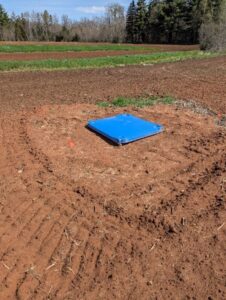
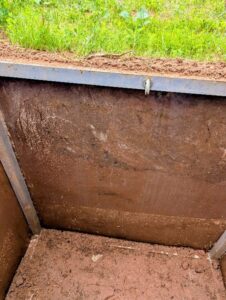
Figure 1 and 2: The rhizotron in place. Picture on left from early May 2025, on right from mid-June 2025. Notice the depth of the roots are 50+cm in places.
In a scenario with good plant survival and establishment, the plan is to manage each half of the field as if being managed under different grazing conditions for the 2026 season and beyond. One half of the field will be mowed weekly, to crudely simulate conventional grazing where animals have unlimited access to a large field over a season and have immediate access to new plant regrowth. The other half will be mowed based on plant height, similar to a grazier keeping animals off a paddock until grass has fully recovered from the previous grazing.

Figure 3: This is the set-up of the demo. The entire blue area is planted in a long-term pasture mix. The light blue half will be mowed once a week mimicking continuous grazing where plants are not rested. The dark blue half will be mowed according to plant height simulating adaptive rotational grazing. The green represents the rhizotron.
Root growth and regrowth is directly affected by how stressed the plant is and how much leaf matter is left to photosynthesize and grow. We are expecting to see shorter, more shallow root systems where we have mowed weekly compared to the sides where we have mowed based on plant height. A well-developed root system and managed grazing will sequester more carbon into soil, be more resilient to drought and provide better quality forage to livestock. (Please note, a key piece of grazing is missing from our demo: the animal impact on the pasture. For the purposes of the demo, though, mowing is okay!)
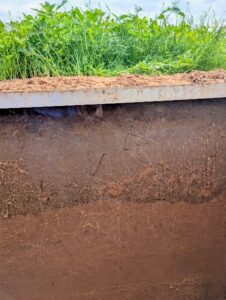
Figure 4: This photo from mid-June 2025 shows visible roots and the newly-established forage mix.
Stay tuned to see updates in the 2026 season!