
It is that time of year, the opportunity to utilize manure. Storage is full, and plant 2026 is getting underway. It has been a cold and wet start to the year and with fertilizer prices the way they are (painful), it is yet another opportune time to try and get the most of our on-farm nutrients.
If you do not feel like reading too much today, here are some quick spring manure tips to jog your memory before you start hauling.
Top 10 Spring Manure Quick Tips:
- Sample Manure and Soil: Sample manure and soil for actual nutrient content for crop requirements.
- Monitor Weather: Check forecasts; avoid applying before significant rainfall to prevent runoff.
- Prioritize Low-Risk Fields: Spread on fields with high crop residue or growing crops such as cover crops, or perennials first to avoid run-off and manage time.
- Avoid Wet Soils: Avoid applying manure to saturated soil to prevent significant compaction.
- Start with Dryer Ground: Start on higher, drier ground first, and save poorly drained or low-lying areas for late spring.
- Wait to Plant: Allow at least 1–2 weeks between application and planting to avoid plant injury from decomposing manure.
- Incorporate: If broadcasting liquid or solid on bare soil consider immediate incorporation for reduced ammonia losses. This are lower in cooler spring temperatures but high in dry/windy conditions.
- Calibrate Equipment: Ensure spreaders are calibrated to apply the proper, calculated rate to avoid over-application.
- Reduce Load Weight: If fields are marginal in wetness, fill tankers to less than full capacity to reduce machine weight and compaction.
- Nutrient Management Planners: Contact a specialist or consultant that can assist with an NMP well in advance of spring to help manage on-farm nutrients best.
Also check out some of our factsheets for the upcoming season:
OFCAF-Manure-in-Nova-Scotias-Poultry-IndustriesV2.pdf – NEW
Reducing-the-Greenhouse-Gas-Emissions-from-Manure-ApplicationV2.pdf
Liquid-Manure-Injection-Pros-and-ConsV2.pdf
If you are interested in reading more, here are some other considerations.
Consider the Goal:
At bare minimum, the goal is to utilize manure for its nutrients for this season’s crop. When we keep this in mind, we value our manure in crop production while minimizing environmental losses. Nitrogen is typically a goal in nutrient management but when it comes to manure, it is extremely important to consider phosphorus (P) levels to minimize over application of P. Regardless of how we think about manure application, we can easily over complicate the decision-making process as there are logistics, weather, and field conditions to consider.
Nutrient management planners and Environmental Farm Plans are the best way to start planning for the right way – cost, nutrients, and environmental – to plan your spring decision making.
Equipment
If you are applying solid, semi-solid, or liquid manure an obvious first thought to an individual’s production system is equipment options. Globally, there are a lot of advanced technology to help us manage manure properly. Broadcasting manure is a common, easy and inexpensive practice but it can result in a loss of ammonia (NH3), and nitrate and phosphorus runoff. If broadcasting – ensure incorporation is occurring within 48 hours.
Liquid: Tanker style spreader that have shallow injection, drop hose, dribble bars, and trailing shoes are both methods of low emission slurry spreading (LESS). The primary difference is where the liquid manure is being places – in soil application (typically 1-5 cm), on the soil surface, or higher soil disturbance as it cuts through soil). Overall, these all reduce odour, preserve nutrients, and improve uniformity.
Solid: For solid manure, we have side slingers that typically put most of the product close to the spreader. And more so, we now have beaters which push manure back and break it up. Vertical beaters tend to be the option for today. They break up thick packs and have a consistent spreading pattern and even distribution. This can be important for direct seeding as you do not want large clods throughout the field.

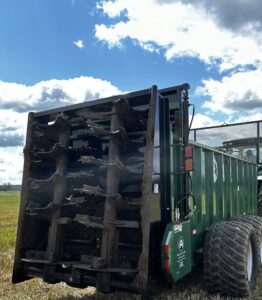

If you are unaware, under the OFCAF program, producers are eligible up to $30,000 towards equipment that allows for better placement and utilization of nutrients from their manure. This program is ending in 2027-2028.
Rate
Understanding application rate is a great way to learn more about your nutrients and how they interact with your crops. Whether the manure is from your farm or a neighbour’s, testing is essential. Feed type, bedding material, manure age, agitation or mixing, and storage conditions all influence nutrient content and characteristics. Taking a proper manure sample provides accurate nutrient information that guides effective and responsible application.
Properly knowing your manure’s nutrient content helps avoid both nutrient deficiencies and over-application, which can harm crop growth and the environment. Over-applying phosphorus, for example, can lead to nutrient buildup in soils, increasing the risk of runoff into water bodies. Additionally, aligning manure nutrient rates to crop needs based on soil test results helps optimize yields without wasting nutrients.
You can find guidance on sampling manure through the following resources, with sample drop-off available at NSDA offices throughout the province: Regional Services | novascotia.ca
- How to take a solid manure sample: Taking-a-compost-sample-and-a-solid-manure-sample-FINAL.pdf
- How to take a liquid manure sample: Liquid-Manure-Sampling-Factsheet-FINAL-Updated.pdf
- How to interpret your manure sample: How-to-Interpret-a-Manure-Analysis-Report-4.pdf
Working with a nutrient management planner or local specialist can further tailor your manure use strategy, ensuring nutrient application rates are both agronomically sound and environmentally responsible.
Timing
One of the most impactful tips for spring manure application is to focus on timing relative to crop planting and weather. Applying manure 2 to 4 weeks before planting allows nitrogen to mineralize and become available for the crop while reducing the risk of seedling injury from fresh manure.
Also, closely monitor short-term weather forecasts. Applying manure when a gentle rain is expected can help naturally incorporate surface-applied manure without risking runoff, but avoid spreading manure ahead of heavy rainfall events that can wash nutrients away.
In summary, plan your manure application dates to optimize nutrient availability, minimize environmental risks, and complement your planting schedule. This deliberate timing helps maximize the return on your manure investment and supports a successful growing season
Calibration
When putting equipment and rate together, we now need to think about calibration your systems. Calibration ensures precise nutrient application. There are various methods for solid manure spreaders including using scales on site and the tarp method. Here are some links:
https://ipcm.wisc.edu/blog/2022/10/manure-spreader-calibration/
http://nmsp.cals.cornell.edu/publications/factsheets/factsheet18.pdf
https://www.uvm.edu/d10-files/documents/2024-08/ManureCalibration.pdf
Stay tuned for our upcoming Manure Spreader Calibration Factsheet.
Placement
We can really dive into placement. Placement or application depends on our source (liquid, semi-solid, or solid), but also our equipment available. Other considerations when it comes to the placement are soil type, crop and field conditions as well as proximity to waterbodies.
Liquid Manure Placement Considerations
Liquid manure placement is vital for optimizing nutrient uptake and minimizing losses. Ideally, liquid manure should be applied in a way that maximizes soil contact and limits exposure to air, as oxygen accelerates nitrogen loss through ammonia volatilization. Injection methods place manure below the soil surface, directly into the root zone. This method can improve nutrient efficiency and reduce odors but involves more soil disturbance. Trailing shoe applicators place manure just above the soil surface, beneath crop canopies, balancing minimal disturbance with effective placement.
Broadcasting liquid manure on the surface is the simplest method, but it is prone to nitrogen loss and runoff if not incorporated quickly. Incorporating broadcast manure into the soil within 24 to 48 hours significantly reduces nutrient losses and improves fertilizer value.
Solid Manure Placement Considerations
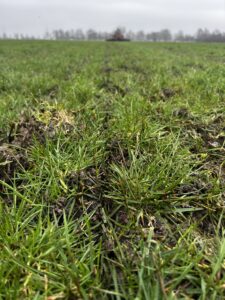
For solid manure, strategic placement is equally important. Spreading solid manure evenly across the field prevents nutrient buildup and reduces the risk of runoff. When spreading on fields going into crops such as corn or small grains, aim to apply manure in a way that allows for subsequent tillage to mix it into the soil. Avoid heavy application near sensitive areas such as waterways, tile drains, or steep slopes to minimize environmental risks. The use of beaters can help break up large manure clumps, ensuring better distribution and faster nutrient availability.
Placement Near Water Bodies and Low-Lying Areas
Manure application near water bodies, wetlands, and low-lying areas requires extra caution to protect water quality. These areas are prone to runoff and nutrient leaching due to proximity to surface water and often poorer drainage. It is best to maintain buffer zones, avoiding manure applications within designated setback distances from streams, rivers, lakes, and wetlands as recommended by local regulations.
Applying manure on low-lying or poorly drained fields should be minimized or timed carefully to avoid saturated conditions that increase runoff risk. Consider applying manure earlier on well-drained, higher ground to allow time for nutrient infiltration before any heavy rains. Where possible, use equipment and application methods that reduce surface runoff, such as injection or trailing shoes for liquid manure..
Soil Type and Manure Management
Soil texture profoundly impacts nutrient retention and losses. Clay and loamy soils tend to hold nutrients better and reduce leaching risks but can have a higher tendency for surface nitrogen loss if manure is left unincorporated. Sandy or well-drained soils pose a higher risk for nutrient leaching, especially nitrogen, making timely incorporation and correct application rates critical. Understanding your soil type allows better manure management practices to maximize nutrient uptake.
Timing and Weather – A Balancing Act
Applying manure 2 to 4 weeks prior to planting helps ensure nutrients have time to mineralize and be available to the crops at the right time. However, timing must be balanced with weather conditions because:
- Rainfall: Light rain shortly after application can help incorporate manure naturally from the surface, but avoid heavy rain events that risk runoff.
- Temperature: Hot, dry weather causes rapid nitrogen losses through ammonia volatilization when manure is surface-applied. Aim to incorporate manure the same day if under these conditions.
- Soil Moisture: Avoid spreading on saturated or frozen soils to reduce compaction and runoff risk.
Environmental Stewardship and Funding Opportunities
Using manure effectively not only benefits your crop but also protects water quality and soil health. Programs like OFCAF help producers invest in equipment that improves nutrient placement and reduces emissions, making manure management more sustainable. Plan ahead to take advantage of these funding opportunities before the program closes in 2027-2028.
Final Thoughts
Manure is a valuable on-farm resource. Thoughtful management from sampling to equipment choice, to timing, and weather monitoring can help you maximize nutrient use efficiency while safeguarding your fields and the environment. Working with nutrient management specialists and taking advantage of agricultural support programs will add value to your operation in the long run