
Happy Monday !
With the summer heat coming in earlier and hotter each year, breaking records and creating production questions and challenge, BMPs such as cover cropping, rotational grazing, and better nitrogen management can become more important tools in our proverbial toolshed. Ever curious about some of those warm season cover crops that may be optional to not only cover the soil, add nutrients such as nitrogen, and also be used for supplemental feed? We did an on-farm demonstration in Middleton, Nova Scotia, with beef and field crop producer John Bruce in 2025. Not knowing this would be the dryest season on record, the planting of sun hemp was not a bad choice.
Have a read and if you have any questions, please reach out to Forage specialist, Shane Wood
Sun Hemp: A Warm Season Legume Worth a Second Look in Nova Scotia?
Shane Wood, P. Ag., Forage specialist/Lead Research Coordinator
Are cool season legumes still the right answer as we continue to see changes in summer temperatures? Are there alternative options out there that can better cope with these rising temperatures? Are there alternative annual legumes which could be combined with other cover crops to add nitrogen fixation capabilities into the mix? These were some of the questions asked when I was approached by a farmer regarding the warm season annual legume, sun hemp.
Unfortunately, there is no information on growing sun hemp in Nova Scotia and much of the information is out of the United States, from regions unlike our own. To answer these questions, demonstration plots were planted during the 2025 growing season on the producer’s farm in the Annapolis Valley. The goals of the demonstration were to showcase the impact of changes in seeding rate on sun hemp soil coverage and demonstrate how sun hemp performs when paired with other cover crop options like buckwheat, balansa clover or ryegrass. This demonstration was funded by the On-Farm Climate Action Fund which supports the adoption of increased cover cropping, rotational grazing and improved nitrogen management.
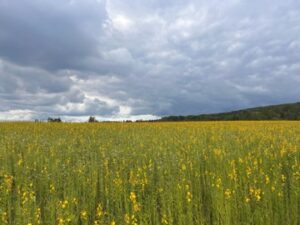
Figure 1: A field of sun hemp in flower (August 29, 60 days after planting: Photo credit: Lindsay Scott)
In the growing season of 2025, the weather was less than favorable. Initially our farmer collaborator had difficulty getting fields prepared due to the wet conditions in the spring that impacted not only our demo site but also caused issues with preparing and sowing his planned crops. On July 1, the demo plots were sown into a heavy clay soil (first ploughed May 12). Six plots of sun hemp were sown at various rates and mixtures including; 20 lbs/acre, 40 lbs/acre and 60 lbs/acre of only sun hemp. The plots in mixes included sun hemp at 40 lbs/acre with buckwheat at 40 lbs/acre; sun hemp at 40 lbs/acre with balansa clover at 5 lbs/acre, and sun hemp at 40 lbs/acre and ryegrass at 50 lbs/acre. To ensure a good representation all plots were approximately 0.36 acres in size. The plots were sown with a Great Plains 1210 no-till drill just over 2.5 cm (1 inch) deep, which is deeper than the recommended 1.25 cm -2.5 cm (0.5 inch – 1 inch) depth.
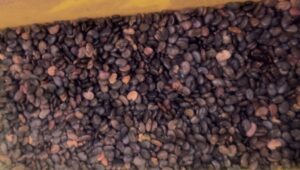
Figure 2: Sun hemp seed (March 17: Photo credit: John Bruce)
To further add to the adversity of the demonstration, little rainfall occurred at the demonstration site in Middleton, Nova Scotia after planting, which limited emergence and seedling establishment. Fortunately, as the season progressed, the few rainfalls we had eventually lead to plant establishment and growth for the sun hemp and sun hemp with buckwheat plots however the balansa clover and ryegrass did not establish well.
From what we saw, sun hemp is a tall growing plant that had limited branching at the seeding rates we chose. Some literature indicates improved branching when sown at lower seeding rates than the lowest rate used in our demonstration. However, for a shorter season cover crop, the recommendation is for these higher rates to allow adequate biomass production which can be incorporated back into the soil. Sun hemp is known to tolerate drought and hot weather, which was in abundance this year, but despite this, biomass production was limited with plants reaching 75 cm – 132 cm in height. Reference information would put this at the low end compared to heights seen in other locations.
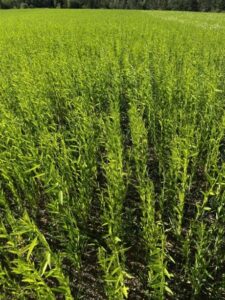
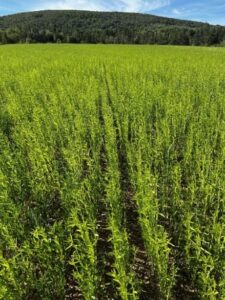
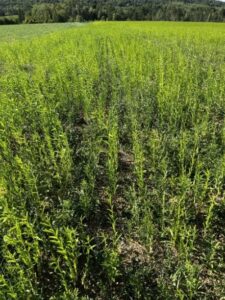
Figure 3: Sun hemp photos taken August 19. From left to right: 20 lbs/acre, 40 lbs/acre, and 60 lbs/acre.
One factor to keep in mind is that in order for nitrogen fixation to occur, legumes need to be inoculated with the appropriate inoculum containing compatible rhizobia species, which in this case is cow pea inoculant. Unfortunately, the producer did not have this on hand. Therefore, the sun hemp plants were left to attempt to establish a symbiotic relationship for nitrogen fixation with whatever existing rhizobia was in the soil. It’s possible that a symbiotic relationship may have been formed but with a less productive rhizobia partner. The lack of nodule development would limit nitrogen fixation and could be a driving reason for the limited plant growth. This is a good reminder for us to ensure that inoculators are available and included in planning to ensure the best chance for optimum nitrogen fixation.
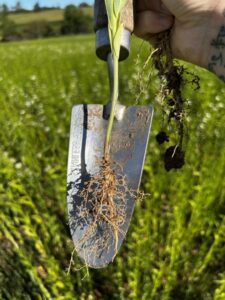
Figure 4: Roots of the sun hemp with little observed nodules. Photo taken August 19.
For the mixed plots, buckwheat was able to establish and provide additional biomass to the sun hemp. Buckwheat is known to draw phosphorus from deeper into the soil and, when terminated, leaves that phosphorus in the typical root zone for other plants. The idea with this mixture was to see if the buckwheat and sun hemp combination would improve availability of phosphorus from the buckwheat and nitrogen from the nitrogen fixing of the sun hemp. The addition of balansa clover was to provide nitrogen fixation from an annual cool season legume and the addition of ryegrass was to provide biomass and ground cover.
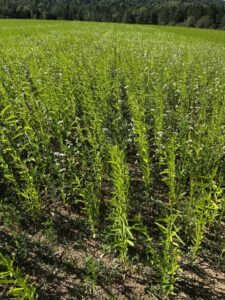
Figure 5: Sun hemp planted at 40 lbs/acre with buckwheat at 40 lbs/acre. Photo taken August 19.
For cattle producers, sun hemp can be grazed or fed to cattle and so there is the possibility to no-till it into pastures or stored forage stands to improve nitrogen fixation. With this in mind, before termination samples were taken from the sun hemp plots when the plant was in bloom and samples were sent for feed analysis at the Nova Scotia Analytical Lab in Bible Hill. The results were surprising in that there was less crude protein content than expected despite being a legume. This may have been due to the lack of nitrogen fixation occurring due to not using an inoculant at seeding. The acid detergent fiber (ADF) content was similar to that seen for other legumes.
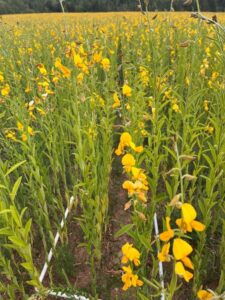
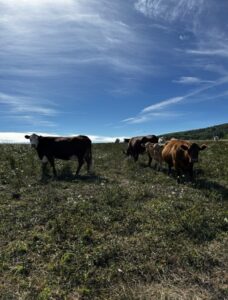
Figure 6: Left: Sun hemp, single stem plant with almost no branching with yellow flowers. Photo taken August 29 (Photo credit: Lindsay Scott). Right: Cattle grazing August 19 in adjacent field in dry summer conditions.
At this time a different method to demonstrate the potential of sun hemp would need to be explored to better showcase the full benefits of this cover crop. Benefits we found were that sun hemp can be sown as late as July 1 and will create some biomass, which could then be ploughed down into the field as a green manure. The single stem and tall growing nature of sun hemp could pair well with a lower growing and bushier crop partner to help hold soil in place.