
Nitrogen fertilizer is an important input for many crops, but it is not always the only source of nitrogen available in the field. Legume cover crops, manure, compost, and residual nitrogen from previous manure applications can all contribute nitrogen to the crop. If these sources are not accounted for, more fertilizer may be applied than the crop requires, increasing input costs and reducing nitrogen use efficiency.
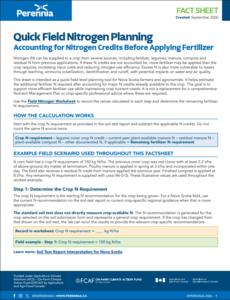
To make this easier, Perennia has developed two new resources: Quick Field Nitrogen Planning: Accounting for Nitrogen Credits Before Applying Fertilizer and the accompanying Field Nitrogen Worksheet. These tools are designed to help farmers and agronomists estimate how much additional fertilizer nitrogen may be needed after accounting for the major nitrogen sources already available in a field.
The approach is straightforward. Start with the crop nitrogen requirement, then subtract applicable nitrogen credits from legumes, manure, compost, and other documented sources. The amount remaining is the fertilizer nitrogen requirement. The worksheet provides a simple way to work through the calculation for an individual field or management zone.
One important consideration is that not all nitrogen in manure or compost is immediately available to the crop. With manure, availability depends on factors such as the ammonium and organic nitrogen content, application timing, and how quickly it is incorporated. Compost generally releases nitrogen more slowly, while manure applied in previous years may continue to provide a residual nitrogen credit.
The worked example in the factsheet shows how much these credits can matter. In the example, a corn crop with a nitrogen requirement of 150 kg N/ha receives nitrogen from red clover, current-year poultry manure, residual manure nitrogen, and compost. Together, these sources provide an estimated 124.8 kg N/ha, leaving only 25.2 kg N/ha to be supplied by fertilizer, equivalent to approximately 55 kg/ha of urea.
The goal of these resources is to support practical, field-level nitrogen planning. Accounting for the nitrogen already available in the field can help farmers make more informed fertilizer decisions, improve nitrogen use efficiency, and avoid unnecessary applications.